产品描述
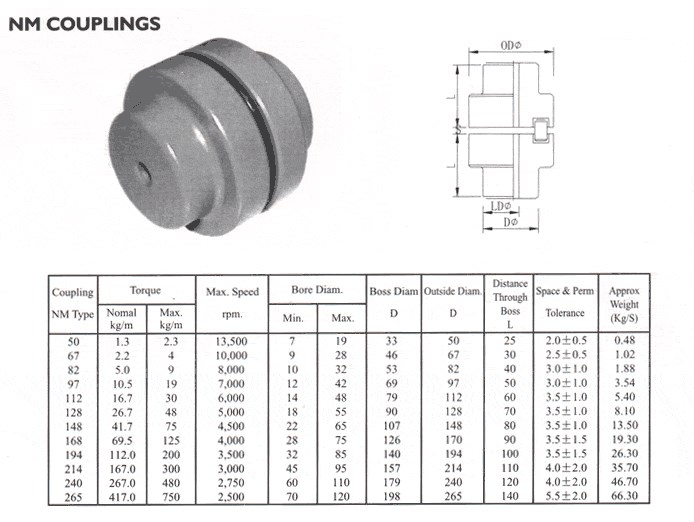
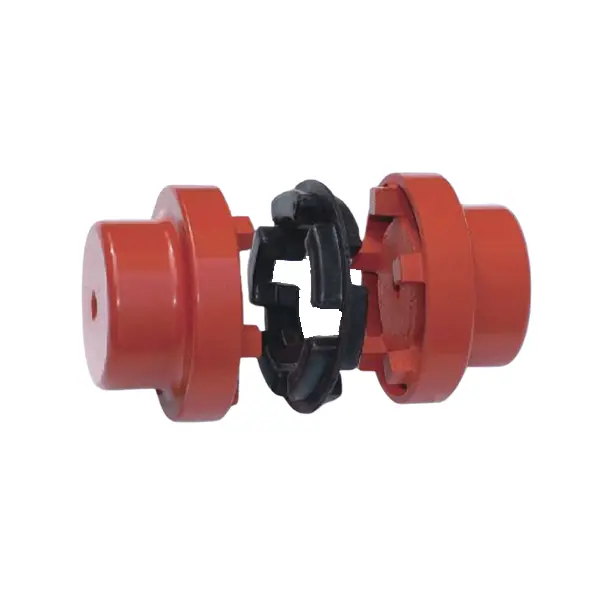
Flexible Cast Iron Forged Steel Quick Release Nm Coupling with Rubber Element Water Pump motor Shaft Coupling Nm
1. Material: Cast iron, Rubber.
2. OEM and ODM are available
3. High efficient in transmission
4. Finishing: Painted.
5. High quality with competitive price
6. Different models suitable for your different demands
7. Stock for different bore size on both sides available.
8. Application in wide range of environment.
9. Quick and easy mounting and disassembly.
10. Resistant to oil and electrical insulation.
11. Identical clockwise and anticlockwise rotational characteristics.
12. Small dimension, low weight, high transmitted torque.
13. It has good performance on compensating the misalignment.
Related products
| 标准或非标准: | 标准 |
|---|---|
| 轴孔: | 19-32 |
| 扭矩: | >80N.M |
| 孔径: | 19mm |
| 速度: | 4000r/M |
| 结构: | Flexible |
| 示例: |
US$ 9999/Piece
1 件(最低订购量) | |
|---|
How does a flexible coupling protect connected equipment from shock loads and vibrations?
Flexible couplings play a crucial role in protecting connected equipment from shock loads and vibrations by providing damping and isolation capabilities. When machines or mechanical systems experience sudden shock loads or vibrations, the flexible coupling acts as a buffer, absorbing and dissipating the impact, thereby reducing the transmitted forces and protecting the equipment. Here’s how flexible couplings achieve this:
- Damping of Vibrations: Flexible couplings are often made from materials that exhibit damping properties. When vibrations are transmitted through the shafts, the flexible coupling’s material can absorb a portion of the vibrational energy, converting it into heat. This dissipation of energy helps reduce the amplitude of the vibrations and prevents them from propagating further into the connected equipment.
- Vibration Isolation: In addition to damping vibrations, flexible couplings also offer a degree of vibration isolation. They are designed to decouple the two shafts, which means that vibrations occurring on one shaft are not directly transmitted to the other shaft. This isolation effect prevents vibrations from propagating across the entire system and minimizes the impact on sensitive equipment or nearby components.
- Shock Absorption: When the connected machinery experiences sudden shock loads, such as during a startup or abrupt changes in load, the flexible coupling can act as a shock absorber. The coupling’s design allows it to deform slightly under the impact, absorbing and distributing the shock energy. This prevents the shock from being directly transferred to the connected equipment, reducing the risk of damage or premature wear.
- Misalignment Compensation: Flexible couplings are capable of compensating for misalignment between the shafts. Misalignment can lead to additional stresses and vibrations in the system. By allowing for some degree of angular, parallel, and axial misalignment, the flexible coupling reduces the forces transmitted to the connected equipment and the supporting structures.
- Reduction of Resonance Effects: Resonance is a phenomenon that occurs when the natural frequency of a system matches the frequency of external vibrations, leading to amplified vibrations. Flexible couplings can help avoid resonance effects by altering the system’s natural frequency and providing some level of flexibility that damps the resonance response.
By incorporating a flexible coupling into the drivetrain or power transmission system, equipment manufacturers and operators can significantly improve the reliability and longevity of connected machinery. The coupling’s ability to dampen vibrations, isolate shocks, and compensate for misalignment contributes to a smoother and more stable operation, reducing maintenance requirements and enhancing overall system performance.
In summary, flexible couplings act as protective elements, shielding connected equipment from shock loads and vibrations. Their ability to dampen vibrations, isolate shocks, and compensate for misalignment contributes to a smoother and more reliable operation of various mechanical systems.
How does a flexible coupling impact the overall reliability of connected equipment?
A flexible coupling significantly impacts the overall reliability of connected equipment in several ways:
- Misalignment Compensation: Flexible couplings can accommodate both angular and parallel misalignment between connected shafts. By allowing for misalignment, the coupling reduces the stress and wear on bearings, seals, and other rotating components. This feature prevents premature failure of these components, contributing to improved reliability and extended equipment lifespan.
- Vibration Damping: Flexible couplings possess inherent damping properties due to their elastomeric or flexible elements. These elements absorb and dissipate vibrations generated during the operation of machinery. By dampening vibrations, the coupling protects the connected equipment from excessive oscillations, reducing fatigue and preventing mechanical failures. This enhanced vibration control increases the reliability of the system.
- Shock Load Absorption: In applications with sudden load variations or shock loads, such as in heavy machinery or high-speed equipment, a flexible coupling acts as a shock absorber. It can absorb and dissipate the impact energy, protecting the machinery from damage caused by sudden loads. The ability to absorb shock loads contributes to the overall reliability of the connected equipment.
- Reduced Wear and Tear: The flexibility of the coupling minimizes stress and wear on rotating equipment. It allows for slight movements and misalignments, reducing friction and stress on bearings and other critical components. This reduction in wear and tear lowers the frequency of maintenance and replacement, increasing the overall reliability of the equipment.
- Compensation for Thermal Expansion: Temperature changes in machinery can lead to thermal expansion or contraction of shafts. A flexible coupling can compensate for these thermal effects, ensuring that the machinery remains properly aligned even as temperature conditions fluctuate. This compensation prevents binding and misalignment, promoting reliable performance.
- Protection Against Overloads: Flexible couplings help protect connected equipment from overloads and torsional vibrations. They act as a mechanical fuse, disconnecting the driveline when an overload occurs, thus preventing damage to expensive machinery. This safety feature enhances the overall reliability and reduces the risk of catastrophic failures.
- Easy Maintenance and Alignment: Flexible couplings are designed for easy installation and alignment. This feature simplifies maintenance procedures, making it easier to inspect and replace couplings when necessary. Properly aligned couplings lead to improved equipment performance and longevity, enhancing overall reliability.
By compensating for misalignment, damping vibrations, absorbing shock loads, reducing wear and tear, and providing other protective features, a flexible coupling significantly improves the reliability of connected equipment. It extends the lifespan of critical components, minimizes downtime, and ensures smooth and efficient operation, making it a valuable component in various industrial applications.
柔性联轴器制造中通常使用哪些材料?
柔性联轴器采用多种材料制造,每种材料都具有不同的性能和特性,适用于特定的应用。材料的选择取决于多种因素,例如应用要求、环境条件、扭矩容量和所需的柔性。以下是一些柔性联轴器制造中常用的材料:
- 钢: 钢材因其强度高、耐久性好以及优异的扭矩传递性能,被广泛用于柔性联轴器中。钢制联轴器适用于扭矩要求高、运行条件恶劣的重载工业应用。
- 不锈钢: 在腐蚀性较高的环境中,不锈钢常用于制造柔性联轴器。不锈钢联轴器具有优异的抗锈蚀和其他腐蚀性物质的能力,使其成为船舶、食品加工和化工行业应用的理想选择。
- 铝: 铝制联轴器重量轻、惯性小、平衡性好,常用于对重量要求极高的应用领域,例如航空航天和机器人行业。
- 黄铜: 黄铜接头因其良好的导电性而闻名,常用于需要电气接地或电气隔离的场合,例如某些工业机械或电子设备。
- 铸铁: 铸铁联轴器具有良好的强度和耐久性,常用于需要抵抗冲击载荷和振动的工业应用中。
- 塑料/聚合物: 一些柔性联轴器采用高性能聚合物或塑料,例如聚氨酯或尼龙。这些材料具有良好的柔韧性、低摩擦系数和耐化学腐蚀性。塑料联轴器适用于对耐腐蚀性和轻量化要求较高的应用场合。
- 弹性体: 弹性体被用作许多柔性联轴器中的柔性元件。天然橡胶、氯丁橡胶或聚氨酯等材料常用作弹性体连接臂,它们具有柔韧性和减振性能。
联轴器材料的选择取决于具体应用需求。例如,高性能和重载应用可能需要坚固耐用的钢或不锈钢联轴器,而对重量要求极高的应用则可能更适合使用铝或聚合物联轴器。此外,应用运行环境的温度范围、化学腐蚀和电气要求等因素也会影响材料的选择。
制造商通常会提供其联轴器的材料规格,帮助用户根据其应用的具体需求做出明智的决定。


editor by CX 2023-09-06